

Company formation in Jordan for foreigners starts with choosing the right legal form, preparing the required documents, registering the company, and getting the licenses linked to the business activity. The process differs depending on whether the investor wants to set up a new Jordanian company or register a branch of a foreign company already established outside Jordan.
In this article, we explain the main steps for registering a company in Jordan for foreigners, the key legal requirements, suitable company types, open and restricted activities, and the duties that should be checked before and after registration.
Are you planning to set up a company in Jordan and unsure about foreign ownership rules or registration steps? The corporate lawyers at Al-Atassi Law Firm can help you choose the right legal form, review license needs, and guide you through the company formation process clearly.
Best Types of Companies for Foreign Investors in Jordan
Before starting company formation in Jordan for foreigners, the investor should choose the right legal form for the business activity. The company type affects liability, capital, management, licenses, and registration documents.
The main legal forms that may suit foreign investors include:
Limited Liability Company
A limited liability company is one of the most common legal forms for small and medium-sized businesses. It offers simple management and generally separates the company’s liability from the personal liability of the partners, within the limits of capital and shares.
Private Shareholding Company
A private shareholding company may suit larger projects or businesses with several shareholders. It may also be useful when the project needs a wider management structure or more detailed financial and administrative rules.
Branch of a Foreign Company
A branch of a foreign company may suit a company already registered outside Jordan that wants to work or execute contracts inside the Kingdom. This route is different from setting up a new Jordanian company and has its own registration requirements.
If the foreign company is already established outside Jordan and wants to operate or execute contracts inside the Kingdom, it is better to review the requirements for registering a branch of a foreign company in Jordan before choosing this route.
Choosing the Legal Structure Before Registration
Choosing the company type is not only a formal step. It affects the required documents, the partners’ liability, the management structure, and the tax and legal duties that may apply after registration.
Steps to Establish a Company in Jordan for Foreigners
Before a foreign investor starts the company formation process in Jordan, the business activity and legal form should be clear. Registration and license requirements may differ depending on the company type and the activity.
Companies in Jordan are registered through the Companies Control Department under the Jordanian Companies Law No. 22 of 1997 and its amendments.
1. Choosing the Legal Structure of the Company
At this stage, the investor chooses the right legal form based on the business activity, number of partners, and liability limits.
2. Reserving the Trade Name
The investor chooses a trade name that is allowed and does not conflict with the name of an existing company. This is one of the first practical steps before submitting the registration application.
3. Preparing the Memorandum and Articles of Association
The memorandum and articles of association are prepared in Arabic, with certified translation when needed. These documents should include the partners’ details, capital, shares, management rules, company objectives, and founders’ rights and duties.
4. Submitting the Registration Application
The application is submitted to the Companies Control Department with the required documents. These may include founders’ details, company address, memorandum of association, articles of association, and any other document required for the selected company type.
The Companies Control Department allows company registration applications to be submitted electronically for several types of companies.
5. Obtaining Approvals and Licenses
Some activities may need approvals or licenses from special authorities before or after registration. This may apply to professional, industrial, health, financial, or other regulated activities.
6. Completing Tax and Post-Registration Steps
After registration, the investor should complete the next steps, such as tax registration, obtaining a tax number, securing professional licenses when required, and updating company and beneficial owner information.
Capital, documents, and approvals may differ depending on the company type and business activity. Therefore, the requirements should be checked before submitting the application.
After registration, companies that plan to hire non-Jordanian employees should also consider the requirements for work permits and residency for expatriates in Jordan.
Requirements for Establishing a Company for Foreigners Under Jordanian Law
Jordanian law does not generally prevent a non-Jordanian from setting up a company. However, some requirements and controls may apply to ensure transparency and protect the local economy.
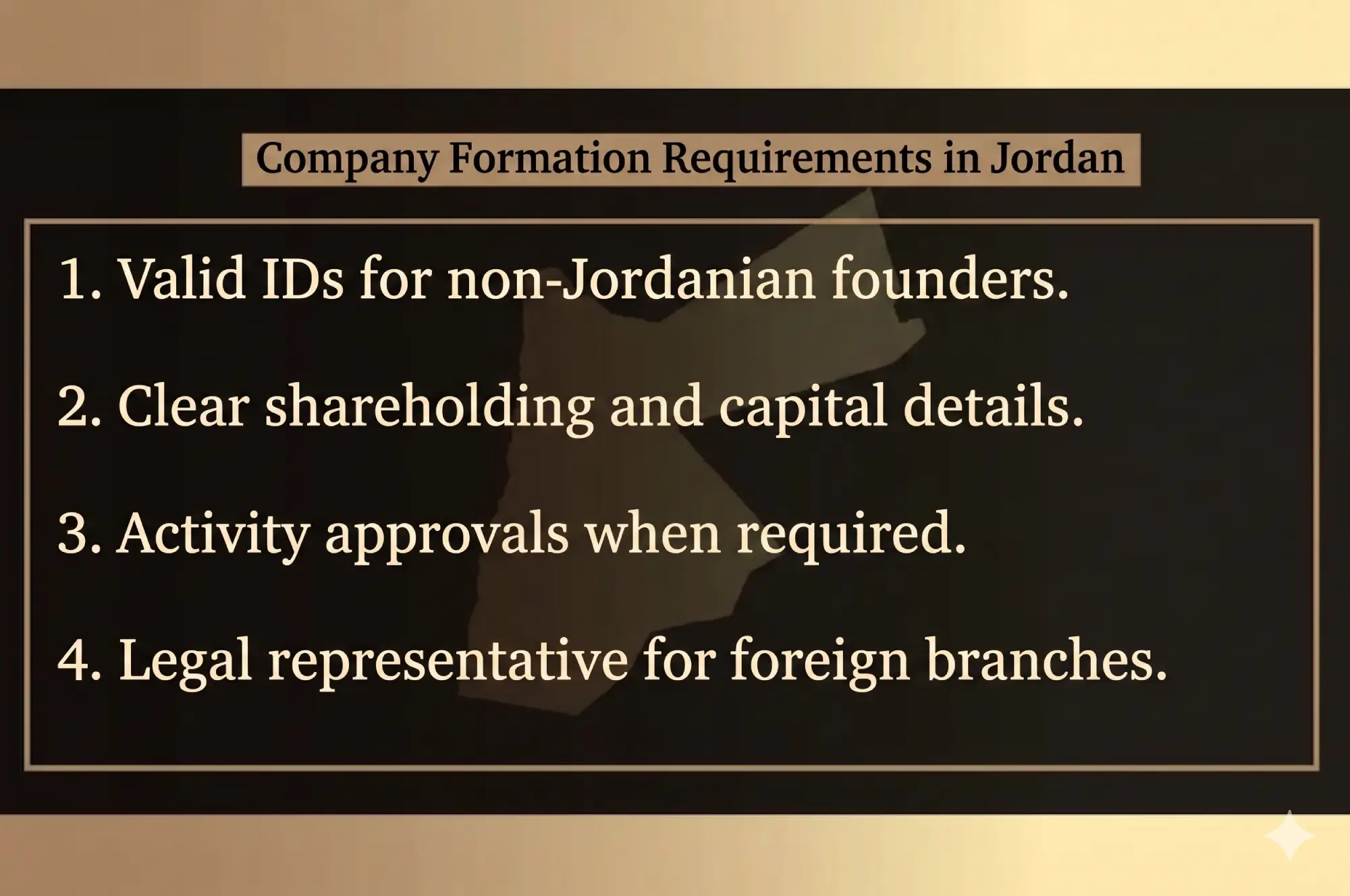
These requirements may include:
- Identifying the non-Jordanian founders and submitting passports or other required identity documents.
- Clearly stating the ownership shares and capital of each founder.
- Checking whether the business activity is open to foreign ownership or subject to limits.
- Registering a foreign branch under the Companies Law when the company already exists outside Jordan.
- Appointing a legal representative in Jordan when required.
- Making sure the company activity is lawful and not used for fraud or purposes against public order.
- Choosing a company name that does not conflict with an existing registered company.
Open and Restricted Sectors for Foreign Investment
The Jordanian market includes activities that may be open to foreign investment and others that may need special approval, local participation, or ownership limits.
Open Activities
Foreign investors may be allowed to own full shares in many activities, unless a law or regulation provides otherwise. Some activities in free zones or development zones may also have special rules and benefits.
Restricted Activities
Some activities may require special approvals, local ownership participation, or license conditions. This may include regulated sectors such as insurance, banking, financial services, transport, energy, or other activities supervised by special authorities.
Because ownership limits may differ by activity, the business activity should be checked before choosing the company type.
Incentives in Development Zones
Companies operating in development zones may benefit from tax, customs, or procedural incentives, subject to the applicable laws and regulations.
Legal Rights and Obligations of Foreign Investors
When a foreign investor enters the Jordanian market, they may benefit from legal protections for their investment. At the same time, they must follow the legal duties that apply to companies operating in Jordan.
Foreign investors may have the following rights and duties:
- The right to transfer foreign capital abroad in a convertible currency, in accordance with the law.
- The right to receive treatment similar to local investors, unless the law provides otherwise.
- The duty to pay local taxes, such as income tax, sales tax, and applicable fees.
- The duty to keep proper accounting records and submit required financial reports.
- The duty to comply with labor, environmental, health, and safety laws.
- The duty to update company information if management, ownership, or address changes.
Investors considering long-term presence in Jordan may also review the available routes for Jordanian citizenship and residency by investment.
Importance of Hiring a Corporate Lawyer for Company Formation
When setting up a company as a foreign investor, working with a corporate lawyer can help avoid mistakes and complete the process correctly from the start.
A corporate lawyer can help by:
- Choosing the right company type for the business activity and risk level.
- Drafting the memorandum and articles of association in a clear legal way.
- Following up on registration and approvals before the official authorities.
- Checking tax, labor, and license duties after registration.
- Representing the company if a dispute, review, or official inquiry arises.
If you are unsure which legal form suits your activity, or whether your business is subject to foreign ownership limits, consulting a corporate lawyer in Jordan can help you start correctly.
Frequently Asked Questions About Company Formation in Jordan for Foreigners
Can a foreigner establish a company in Jordan?
Yes, a foreigner can establish a company in Jordan. However, this depends on the type of business activity, the legal structure, and the permitted foreign ownership percentage. Some sectors are open to foreign investment, while other activities may require special approvals or may be subject to certain restrictions. Therefore, the business activity should be determined before choosing the company type.
What is the best company type for a foreign investor in Jordan?
A limited liability company is often a suitable option for many foreign investors because it is flexible in management and works well for small and medium-sized businesses. However, a private shareholding company or a branch of a foreign company may be more suitable in certain cases, depending on the project size, activity, and number of partners.
Can a non-Jordanian fully own a company in Jordan?
A non-Jordanian may fully own a company in many activities, unless the activity falls within a restricted sector or requires specific ownership percentages or special approvals. Therefore, it is not enough to consider the investor’s nationality alone; the economic activity itself must be reviewed before registration.
What are the steps to register a company in Jordan for foreigners?
The steps to register a company in Jordan for foreigners usually begin with choosing the legal structure, reserving the trade name, preparing the memorandum and articles of association, submitting the registration application to the Companies Control Department, and obtaining the necessary approvals and licenses for the activity. After registration, tax and regulatory requirements must also be completed.
Is there a difference between establishing a Jordanian company owned by a foreigner and registering a branch of a foreign company?
Yes. Establishing a Jordanian company owned by a foreigner means creating a new legal entity inside Jordan, such as a limited liability company. Registering a branch of a foreign company applies when the company already exists outside Jordan and wants to conduct business or execute contracts inside the Kingdom.
How long does it take to establish a company in Jordan for foreigners?
The time required to establish a company in Jordan for foreigners depends on the company type, business activity, completeness of documents, and any required approvals. The process may be completed faster when the documents are ready, while regulated activities may take longer because of licensing or review by competent authorities.
Conclusion
This brings us to the end of our article on company formation in Jordan for foreigners. We explained the registration steps, legal requirements, main company types for foreign investors, and activities that may need special approval or ownership review.
Setting up the company correctly from the beginning helps avoid registration delays and unexpected legal duties later. If you want to open a company in Jordan as a non-Jordanian, you can contact Al-Atassi Law Firm via WhatsApp to review your activity, choose the right legal form, and identify the required licenses.
Read Also:
- Registering Foreign Company Branches in Jordan.
- Work Permits and Residency for Expatriates in Jordan.
- Jordanian Citizenship & Residency by Investment.

Mohammad Jaser Al-Atasi is a lawyer and legal consultant based in Amman, Jordan, with over 25 years of experience in litigation and legal advisory services. He holds a Bachelor of Laws and a Master’s degree in Civil Law, in addition to specialized qualifications in Sharia and Arbitration. He is the founder of Al-Atasi Law Firm and Legal Consultations, where he provides legal services to individuals and businesses in civil, commercial, and criminal matters, as well as contract drafting, legal appeals, and representation before Jordanian courts.