
An Unfair Dismissal Lawyer in Jordan can review your termination, employment contract, correspondence, and evidence to assess your rights and the appropriate legal action.
Al Atassi Law Firm & Legal Consultancy advises employees and employers on dismissal and termination disputes based on the contract, facts, and available documents.
Quick Answer:
An Unfair Dismissal Lawyer in Jordan reviews the employment contract, reason for termination, dismissal notice, warnings, correspondence, salary, and length of service. The lawyer then compares the facts with the legal rules that apply to the case and identifies the possible rights or defenses, relevant evidence, and the appropriate legal route.
Has your employment been terminated and you want to understand your legal position?
Your employment contract, termination notice, correspondence, and entitlements can be reviewed before you take the next step or sign a final settlement.
Request a Review of Your Dismissal
The legal assessment depends on the employment contract, facts, and documents specific to each case.
When Do You Need an Unfair Dismissal Lawyer in Jordan?
Legal review becomes particularly important when the reason for termination or the procedure followed by the employer is disputed. The end of an employment relationship does not automatically mean that the dismissal was unfair, so the way employment ended and the reason relied upon by the employer should be reviewed before reaching a legal conclusion.
You may need legal review if:
- Your employment was terminated unexpectedly.
- You dispute the reason given by your employer for the dismissal.
- You received a dismissal or termination notice and want to understand its legal effect.
- Warnings or disciplinary procedures were issued before termination.
- You have been asked to sign a settlement or release after leaving the job.
- Your financial entitlements after dismissal are unclear.
- You and your employer disagree about the type or duration of the employment contract.
- Correspondence or other documents may affect the assessment of the dismissal.
How Does a Lawyer Determine Whether a Dismissal Was Unfair?
A dismissal is not considered unfair simply because the employee believes the decision was unjust. An Unfair Dismissal Lawyer in Jordan first reviews the facts and documents, then identifies the legal rules that apply to the employment relationship and the reason it ended.
The outcome may also depend on the type of employment contract. Terminating a fixed-term contract can have different legal consequences from ending an indefinite-term contract.
The assessment usually focuses on:
- The type and duration of the employment contract.
- The reason for termination.
- Which party ended the employment relationship.
- The date and method of termination.
- The dismissal or termination notice, if any.
- Previous warnings and disciplinary procedures.
- Correspondence between the employee and employer.
- Salary and length of service.
- Evidence that may help establish the relevant facts.
Who bears the burden of proving the dismissal?
The burden of proof may vary depending on what each party alleges and the reason given for ending employment. Judicial principles published by the Jordanian Judicial Council show that the legality of dismissal is assessed in light of the evidence presented and the grounds relied upon by the employer. Evidence should therefore be reviewed before assuming that the burden always falls on one party.
What Should You Do After Being Dismissed?
Preserving documents from the beginning can make it easier to understand what happened and prove the relevant facts later. Do not treat a dismissal as a purely verbal event when written notices, emails, messages, or other records are available.
- Keep the dismissal notice: Retain any letter, email, or message related to the termination of employment.
- Preserve correspondence: Keep emails and messages connected to the reason for dismissal or the circumstances surrounding it.
- Gather your employment documents: Prepare the employment contract, salary records, warnings, and any disciplinary decisions.
- Record the termination date: The date may be relevant when assessing procedures and rights arising from the end of employment.
- Review any settlement before signing: Understand which amounts and rights the document covers before agreeing to it.
- Seek a legal assessment: Determine whether the facts support a legal claim before starting proceedings or signing a final document.
What Documents Does an Unfair Dismissal Lawyer Need?
Not every dismissal case requires the same documents. However, having the employment contract, termination notice, correspondence, and salary records can make it easier to assess the reason for dismissal and the rights that may arise from it.
| Document | Why Is It Useful? |
|---|---|
| Employment contract | Helps identify the contract type, duration, salary, and terms governing termination. |
| Dismissal or termination notice | Helps establish the date, stated reason, and method of termination. |
| Salary records | Helps establish salary, which may affect the calculation of certain employment entitlements. |
| Warnings | Helps clarify the procedures that took place before termination. |
| Correspondence | May help document communications between the employee and employer about the dispute or dismissal. |
| Settlement or release | Helps assess which rights and payments are covered and the possible effect of signing the document. |
| Attendance or working-time records | May be relevant when the stated reason for dismissal involves absence or working hours. |
What Rights May Be Reviewed After Unfair Dismissal?
Employment rights differ from one case to another, so not every employee whose employment has ended will be entitled to the same amounts. The nature of the termination should first be established, followed by a review of the contract type, length of service, salary, and any rights or amounts already paid.
Under Jordanian Labour Law and official information published by the Ministry of Labour, a finding of arbitrary dismissal may involve statutory compensation, notice pay where applicable, and other employment rights that arise in the particular case. The legal calculation must therefore be applied to the specific facts rather than relying on a general figure without reviewing the file.
The review may include:
- Compensation for arbitrary dismissal where the legal requirements are met.
- Notice pay where applicable.
- Outstanding wages.
- Payment for unused leave where applicable.
- End-of-service benefits where the employee qualifies for them.
- Other rights arising from the employment contract and the way it ended.
Is 60 Days the Deadline for Filing an Unfair Dismissal Claim?
The reference to 60 days in Article 25 does not mean that an unfair dismissal claim automatically expires after 60 days. Official Ministry of Labour guidance explains that this period relates to the court’s power to order reinstatement, while the claim itself remains subject to the limitation rules set by law.
For this reason, it is not accurate to rely on a general statement that an employee has “only 60 days to file an unfair dismissal claim.” The termination date, type of claim, and rights being sought should be identified first, followed by a review of the legal time limit that applies to the specific case.
You can refer to the Jordanian Ministry of Labour’s Labour Law No. 8 of 1996, as amended and supplemented to review the official legal texts.
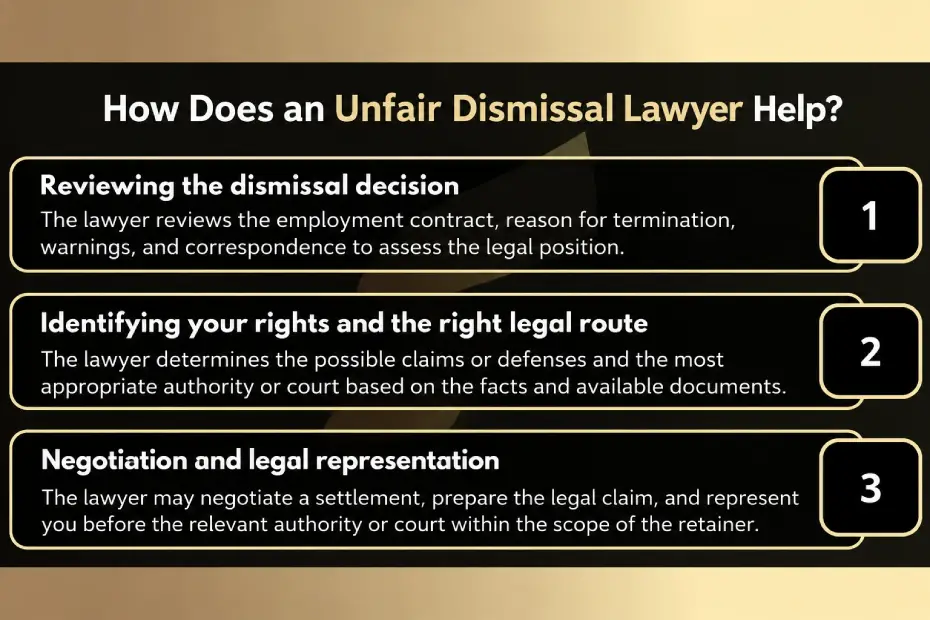
How Can an Unfair Dismissal Lawyer in Jordan Help You?
An Unfair Dismissal Lawyer in Jordan starts by understanding what happened before choosing a legal procedure. The dispute may concern the reason for dismissal, the way the termination was carried out, the entitlements arising from it, or the documents relied upon by either party.
- Reviewing the dismissal decision: Identifying the reason for termination and how it was carried out.
- Reviewing the contract: Identifying the type and duration of the contract and the clauses that may affect termination.
- Analyzing the documents: Reviewing the dismissal notice, warnings, salary records, correspondence, and any settlement document.
- Identifying claims or defenses: Determining which rights have a legal basis and what documents support them.
- Choosing the legal route: Determining whether the matter requires negotiation, a legal claim, or proceedings before the competent authority.
- Representation and follow-up: Taking the agreed legal action and following the matter within the scope of the legal retainer.
If your dispute goes beyond dismissal and also involves wages, employment contracts, leave, or other employment matters, you can review our Employment Lawyer in Jordan service.
Can an Employer Seek Legal Advice About a Dismissal?
Yes. An Unfair Dismissal Lawyer in Jordan does not only advise employees. An employer may also need legal review of the reason for termination, employment contract, warnings, supporting documents, and procedures followed before the decision, or assistance in preparing a defense against an employee’s claim.
Reviewing the matter before termination may also help determine whether the available documents and procedures support the employer’s decision, without assuming that every termination amounts to unfair or arbitrary dismissal.
Do I Need a Lawyer Before Filing an Unfair Dismissal Claim?
Legal review before filing a claim can help identify what needs to be proven and whether the facts and documents support an unfair dismissal allegation. It can also help separate the claims directly connected to termination from other employment rights instead of combining different demands without understanding the legal basis for each one.
Unfair Dismissal Lawyer in Amman and Across Jordan
Al Atassi Law Firm & Legal Consultancy provides legal services for dismissal and termination matters from its office in Amman, Abdali, The Boulevard. The appropriate service depends on the type of employment contract, the reason for dismissal, the stage of the dispute, and the authority that may need to be approached.
Choosing an Unfair Dismissal Lawyer in Jordan does not depend on the location of the dispute alone. The nature of the case, available documents, and the stage the matter has reached are also relevant.
Frequently Asked Questions About Unfair Dismissal in Jordan
How Do I Know If My Dismissal Was Unfair?
You cannot determine this from the dismissal alone. Review the type of employment contract, the reason for termination, the procedure followed by the employer, any warnings, correspondence, and other documents connected to the decision. If the termination conflicts with the legal rules that apply to the case, an unfair dismissal claim may arise after the facts and evidence are assessed.
What Documents Can Help Prove an Unfair Dismissal?
Useful documents may include the employment contract, dismissal notice, salary records, warnings, emails, messages, and any document showing the reason or date of termination. The evidence that matters will vary depending on the dispute, so the absence of one specific document does not automatically prevent the case from being assessed.
Should I Sign a Settlement After Being Dismissed?
Understand the amounts and rights covered by the settlement before signing it, especially if the reason for dismissal or the value of your entitlements is disputed. The legal effect of a settlement may depend on its wording, the circumstances in which it was signed, and the rights it covers, so legal review can be useful before signing.
Can an Employee Be Reinstated After Unfair Dismissal?
Jordanian Labour Law regulates the circumstances and judicial powers related to unfair dismissal, including reinstatement within the conditions and time limits set by law. Reinstatement is not automatically available in every case, so the dismissal date, the timing of the claim, and the facts of the case should be reviewed before deciding what relief may be requested.
Do I Need a Lawyer to File an Unfair Dismissal Claim?
A legal review before filing can help identify the type of contract, the reason for dismissal, the rights that may be claimed, and the evidence supporting each request. It can also help determine the correct authority and procedure and avoid relying on general compensation figures or deadlines that may not apply to the specific case.
Conclusion
An Unfair Dismissal Lawyer in Jordan can review the termination decision, employment contract, notices, correspondence, and employment entitlements before determining whether the facts support a legal claim or a defense of the dismissal decision. A proper assessment starts with the reason for termination and the available evidence rather than assuming that every dismissal is unlawful.
Would you like to review the dismissal decision and your next legal step?
Your employment contract, termination notice, correspondence, and entitlements can be reviewed to identify the nature of the case and the appropriate legal procedure.
Discuss Your Dismissal Case With a Lawyer
The legal assessment depends on the employment contract, facts, and documents specific to each case.
Written by:
Mohammad Jaser Al-Atassi
Published: October 6, 2026
Legal Information Review:
The general legal information on this page has been reviewed with reference to Jordanian Labour Law and official information published by the Ministry of Labour. Each dismissal case should still be assessed according to its specific facts and documents.
Official Sources
Disclaimer:
This content provides general legal information for educational purposes only and does not constitute legal advice for a specific case. Rights, procedures, and outcomes may vary depending on the type of employment contract, the reason for termination, the facts, available documents, and the law applicable to each case.
Mohammad Jaser Al-Atasi is a lawyer and legal consultant based in Amman, Jordan, with over 25 years of experience in litigation and legal advisory services. He holds a Bachelor of Laws and a Master’s degree in Civil Law, in addition to specialized qualifications in Sharia and Arbitration. He is the founder of Al-Atasi Law Firm and Legal Consultations, where he provides legal services to individuals and businesses in civil, commercial, and criminal matters, as well as contract drafting, legal appeals, and representation before Jordanian courts.